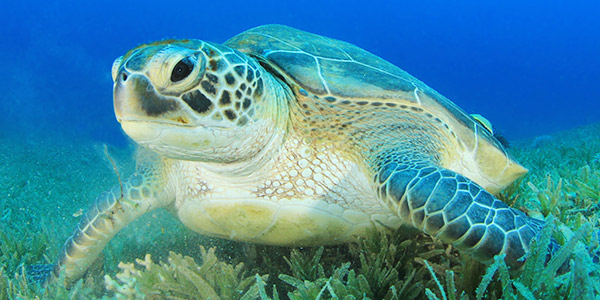
Green Sea Turtle
Chelonia mydas
Also known as: Green Turtle, Pacific Green Turtle
The Green Sea Turtle is one of the largest sea turtle species and the only herbivore among them. Named for the green color of their body fat (from their diet of seagrass), these ancient mariners have roamed the oceans for over 100 million years.
Max Size
5 feet (1.5 m)
Lifespan
60-70 years
Depth
0-40 meters
Water Type
saltwater
Scientific Classification
- Class
- Reptilia
- Order
- Testudines
- Family
- Cheloniidae
- Species
- Chelonia mydas
Habitat & Distribution
Habitat
Distribution
Behavior
Green sea turtles are primarily solitary but gather in groups at feeding and nesting sites. They spend most of their time grazing on seagrass and algae, which helps maintain healthy seagrass beds. They migrate long distances between feeding and nesting grounds.
Reproduction
Females come ashore at night to lay 100-200 eggs in sandy nests. After 45-75 days, hatchlings emerge and make their way to the sea. Only about 1 in 1,000 hatchlings survives to adulthood.
Conservation Status
Main Threats
- Habitat loss
- Fishing bycatch
- Pollution
- Climate change
- Poaching
🎉 Fun Facts
- Green sea turtles can hold their breath for up to 5 hours while sleeping
- They return to the same beach where they were born to lay eggs
- Their body fat is green due to their herbivorous diet
- They can't retract their head into their shell like land turtles
- Females can travel over 1,000 miles to reach nesting beaches

