Back to Species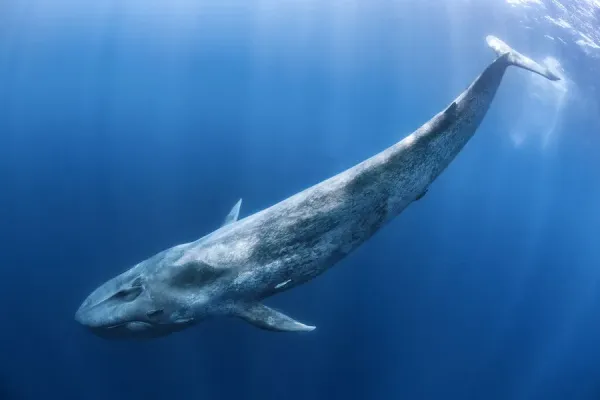
Endangered
Blue Whale
Balaenoptera musculus
Also known as: Sulphur Bottom
The Blue Whale is the largest animal ever known to exist on Earth - larger than any dinosaur. Their hearts are the size of a small car, and a human could crawl through their main arteries. Despite their size, they feed almost exclusively on tiny krill.
Max Size
100 feet (30 m)
Lifespan
80-90 years
Depth
0-500 meters
Water Type
saltwater
Scientific Classification
- Class
- Mammalia
- Order
- Cetacea
- Family
- Balaenopteridae
- Species
- Balaenoptera musculus
Habitat & Distribution
Habitat
Open oceanAll oceans
Distribution
All oceans worldwide
Behavior
Blue whales are generally solitary or found in small groups. They are deep divers and can hold their breath for up to 30 minutes. They produce the loudest sounds of any animal.
Reproduction
Females give birth to a single calf after 10-12 months of gestation. Calves are 23 feet long at birth and nurse for 6-7 months, drinking 100 gallons of milk daily.
Conservation Status
EndangeredPopulation trend: increasing
Main Threats
- Ship strikes
- Entanglement
- Climate change
- Noise pollution
🎉 Fun Facts
- Their heart weighs about 400 lbs (180 kg)
- A blue whale tongue weighs as much as an elephant
- Their calls can be heard over 1,000 miles away
- Baby blue whales gain 200 lbs per day
- They can eat 4-6 tons of krill daily